05/15/2025 | Report
First cost indicator for geological hydrogen storage
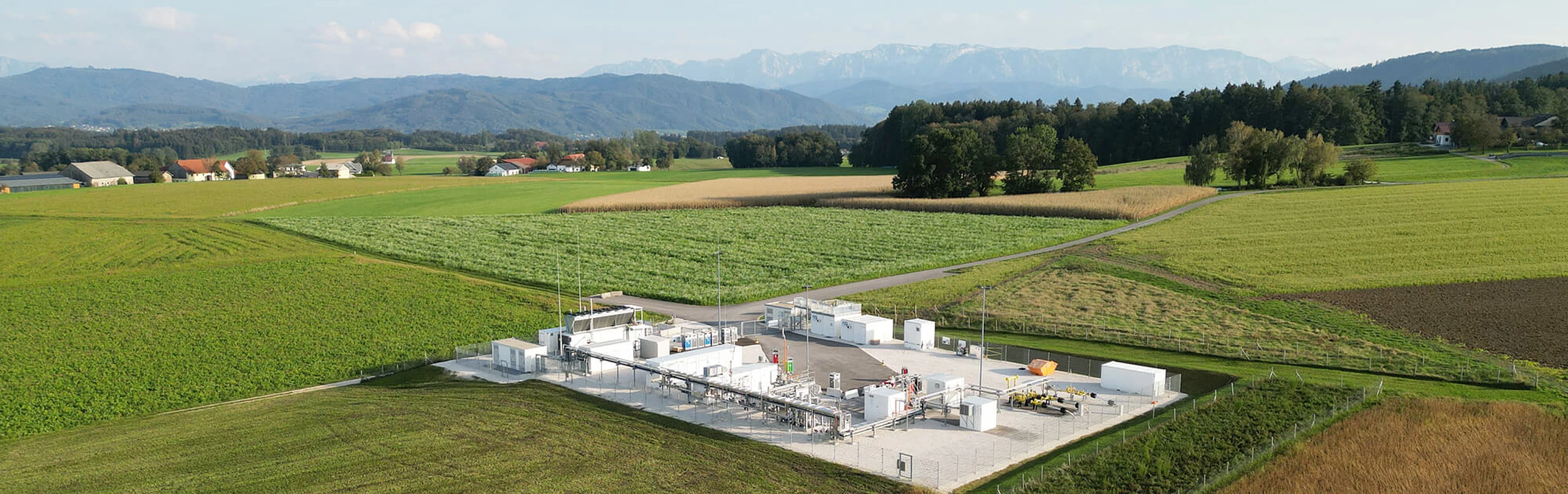
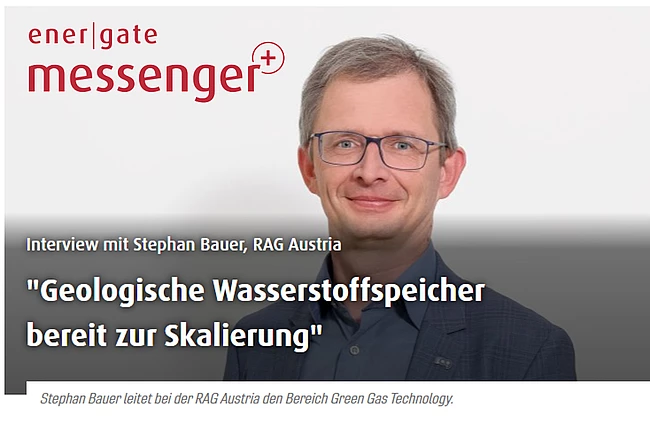
In May, Stephan Bauer, Head of Green Gas Technology at RAG Austria, gave an extensive interview on geological hydrogen storage in the energate messenger. In addition to the successfully conducted storage cycles at Rubensdorf as part of the USS 2030 project, the interview addressed, for the first time, a cost framework for hydrogen storage.
First cost estimates for hydrogen storage
Based on the work carried out so far in the USS 2030 and the follow-up project EUH2STARS project, RAG Austria has, for the first time, provided a benchmark for investment and storage costs. As Stephan Bauer explains in the interview, costs depend heavily on the specific design and reservoir parameters. Nevertheless, initial orientation values can be derived from current experience:
"We estimate investment costs of around 600 to 700 euros per megawatt-hour of storage capacity. This sum covers everything – from drilling and facilities to compressors, pipelines, infrastructure, and the necessary cushion gas. This results in a storage tariff of around 30 to 40 euros per megawatt-hour," says Bauer.
Contextualizing the costs
According to Bauer, these costs cannot be directly passed on to the end-user price of hydrogen. It can be assumed that, similar to natural gas, only a smaller share of total revenue in the hydrogen market will be generated through storage. Converted to the price per kilogram of hydrogen, this means: when only about 20 to 25 percent of the hydrogen needs to be stored for continuous availability, the additional cost of storage amounts to around 20 euro cents per kilogram of hydrogen consumed.
The additional costs of hydrogen storage compared to natural gas storage arise from several factors: hydrogen has a significantly lower energy density than natural gas, hydrogen-compatible components are technically more demanding and expensive, and higher construction costs as well as increased energy requirements for compression and drying also play a central role.
By providing concrete numbers for the first time, RAG Austria creates an important basis for market assessments and simultaneously emphasizes the role of geological storage as a key technology for scaling up a European hydrogen economy.
The full interview with Stephan Bauer can be read in the energate messenger.
Go to interview (only available in German)
 ©
©